INTERESTING INFO ABOUT WALTON ON THE NAZE
Geology
The cliffs to the north of Walton-on-the-Naze consist of London Clay, a rock formed at the bottom of the sea about 50 million years ago when Britain had a subtropical climate. Abovethe London Clay are sands called the Red Crag, part of a remarkable sequence of sediments and sand that are about 3 million years old which have yielded information on the climate at thebeginning of the Ice Age.
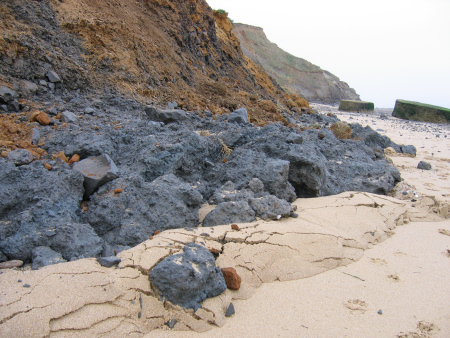
Erosion
Walton can be split into two areas. Northern area which is not protected because the Environment Agency does not consider the buildings worth saving. Southern part which is protected because of the coastal town of Walton behind it with its population of 12,000.
North of the Tower where cliffs are lower: Data shows a strong erosion trend. 4.5 metres per year
The unprotected cliffs close to the Tower: Around 1.6 metres per year.
The cliffs retreat many metres every year so the council have put structures like Crag Walk in place. Did you know that since Roman times the coast has retreated 3 miles inland.
Climate
Walton-on-the-Naze's climate is classified as warm and temperate. Walton-on-the-Naze is a city with a significant rainfall. Even in the driest month there is a lot of rain. This location is classified as Cfb by Köppen and Geiger. In Walton-on-the-Naze, the average annual temperature is 10.2 °C. The rainfall here averages 548 mm
Why do the cliffs erode?
This is because of different types cliff erosion that attacks the cliffs and makes the shoreline move backward overtime.
Cliff Slumping
Cliff slumping is a process that erodes a cliff
|Water soaks through the top layer of rock (Red Crag) | The London Clay is impermeable so the water gets trapped in the Red Crag | The Red Crag gets weighed down | Because the red crag weighs more it slides down to the bottom of the cliff |
Cliff Erosion
Cliff erosion is the most common type of coastal erosion and happens the quickest.
| Weather weakens the top of the cliff | The sea attacks the base of the cliff forming a wave-cut notch | The notch increases in size causing the cliff to collapse | The backwash carries the rubble towards the sea forming a wave-cut platform | The process repeats and the cliff continues to retreat |
Longshore drift
| The wind blows across the beach in one direction | The waves break on to the beach at an angle of around 45 degrees. | The swash moves beach material along the beach | The backwash, under gravity, pulls the material back down the beach at right angles to the coastline | Over time this creates a net shift of material along the coast |
Destructive waves
A destructive wave happens when the backwash is stronger than the swash so the wave washes beach material away. over time the beaches get less absorbent meaning the waves will have more energy.
Landforms
Headland
"Naze" derives from Old English næss "ness, promontory, headland" and Walton on the Naze is the headland of the Naze.
How do headlands form?
Headlands are formed when the sea attacks a section of coast with alternating bands of hard and soft rock. The bands of soft rock, such as sand and clay, erode more quickly than those of more resistant rock, such as chalk. This leaves a section of land jutting out into the sea called a headland. The areas where the soft rock has eroded away, next to the headland, are called bays.
Cliff
A cliff is a steep rock face at the edge of the sea. It originates from the Old English word clif, of Germanic origin; related to Dutch klif .
How does a cliff form?
One of the most common features of a coastline is a cliff. Cliffs are shaped through a combination of erosion and weathering - the breakdown of rocks caused by weather conditions.
Soft rock, eg sand and clay, erodes easily to create gently sloping cliffs. Hard rock, eg chalk, is more resistant and erodes slowly to create steep cliffs.
Beach
A beach is a pebbly or sandy shore, especially by the sea between high- and low-water marks. It originates from a mid 16th century word (denoting shingle on the seashore): perhaps related to Old English bæce, bece ‘brook’ (an element that survives in place names such as Wis bech and Sand bach ), assuming an intermediate sense ‘pebbly river valley’.
How does a beach form?
Beaches are made up of eroded material that has been transported from elsewhere and deposited by the sea. Constructive waves help to build up beaches. The material found on a beach (ie. sand or shingle) depends on the geology of the area and wave energy. A cross-section of a beach is called a beach profile. The shingle ridges often found towards the back of a beach are called berms
Copyright Walton On Naze